What Is a Copper Nickel Alloy?
Cupronickel, often referred to as copper-nickel alloy, is a group of alloys that primarily consist of copper and nickel, with varying compositions tailored for specific applications. Typically, these alloys contain between 60% to 90% copper, while nickel makes up the remaining portion, sometimes with added elements like iron and manganese to enhance specific properties such as strength and corrosion resistance.
This alloy is prized for its remarkable resistance to seawater corrosion, excellent thermal conductivity, and antimicrobial properties. Because of its balanced composition, cupronickel is widely used in industries ranging from marine engineering to coinage and instrumentation.
The appearance of cupronickel varies from silvery to golden depending on the nickel content. The higher the nickel concentration, the more silver-like the metal becomes.
Chemical Composition of Cupronickel
The chemical composition of cupronickel defines its unique properties and suitability for various applications. Below is a breakdown of its key components:
- Copper (Cu): Forms 60% to 90% of the alloy, providing malleability and thermal conductivity.
- Nickel (Ni): Ranges from 10% to 30%, enhancing corrosion resistance and strength.
- Iron (Fe): Typically less than 2%, added to improve strength and resistance to erosion, especially in seawater.
- Manganese (Mn): Usually under 1%, boosts wear resistance and contributes to the alloy’s durability.
- Other Elements: Trace amounts of zinc or tin may be included in specialized grades to tailor properties for specific industrial needs.
- Common Grades:
- 90/10: ~90% copper, 10% nickel, ~1% iron, <1% manganese.
- 70/30: ~70% copper, 30% nickel, ~1% iron, <1% manganese.
- Composition Control: Precise ratios are maintained during manufacturing to ensure consistent performance and reliability.
Properties of Cupronickel
Cupronickel’s appeal lies in its well-balanced mechanical and physical properties, making it suitable for a wide range of applications. Below is a detailed breakdown of its key characteristics:
Mechanical Properties
- Tensile Strength: Varies by grade, with 90/10 cupronickel offering 300–400 MPa and 70/30 reaching up to 500 MPa, providing robust structural integrity.
- Ductility: Exhibits 30–40% elongation, allowing it to deform without fracturing, ideal for forming complex shapes.
- Hardness: Ranges from 70–120 HB (Brinell hardness), ensuring resistance to wear and abrasion in demanding environments.
- Fatigue Resistance: Excellent ability to withstand cyclic stresses, critical for components in marine and industrial systems.
- Work-Hardening: Can harden during machining, requiring careful tool selection to maintain precision and avoid defects.
Physical Properties
- Corrosion Resistance: Forms a protective oxide layer, offering exceptional resistance to corrosion, especially in seawater.
- Density: Ranges from 8.9 to 8.94 g/cm³, slightly denser than pure copper due to nickel content.
- Thermal Conductivity: Approximately 30–50 W/(m·K), suitable for heat exchangers and thermal management systems.
- Electrical Conductivity: Around 5–10% of pure copper’s, limiting its use in high-conductivity electrical applications but suitable for specialized uses like thermocouples.
- Melting Point: Between 1100°C and 1240°C, depending on nickel content, with higher nickel grades having higher melting points.
- Appearance: Silvery-white with a slight golden hue, providing aesthetic appeal for coinage and decorative applications.
- Magnetism: Generally non-magnetic, though trace iron in some grades may introduce slight magnetism.
What are the Different Grades of cupronickel alloy?
The performance and properties of cupronickel vary depending on the composition. Here are the most common grades:
C70600(CuNi 90/10)
This grade comprises 90% copper and 10% nickel, with small additions of iron and manganese. It’s known for good corrosion resistance in seawater and is commonly used for marine applications.
C71500(CuNi 70/30 )
With 70% copper and 30% nickel, this grade offers superior strength and corrosion resistance. It is ideal for more demanding applications such as heat exchangers, condensers, and offshore platforms.
Other Grades
Less common grades, such as 66/30/2/2 (copper, nickel, iron, manganese), are tailored for niche applications. These may include high-strength components for aerospace or specialized industrial equipment. Each grade is carefully engineered to balance cost, performance, and environmental resilience.
The choice of grade depends on the application’s demands, such as exposure to corrosive elements, temperature, or mechanical stress. Manufacturers like those in the machining industry rely on these distinctions to select the right alloy for precision components.
What Is a Copper-Nickel Alloy Used For?
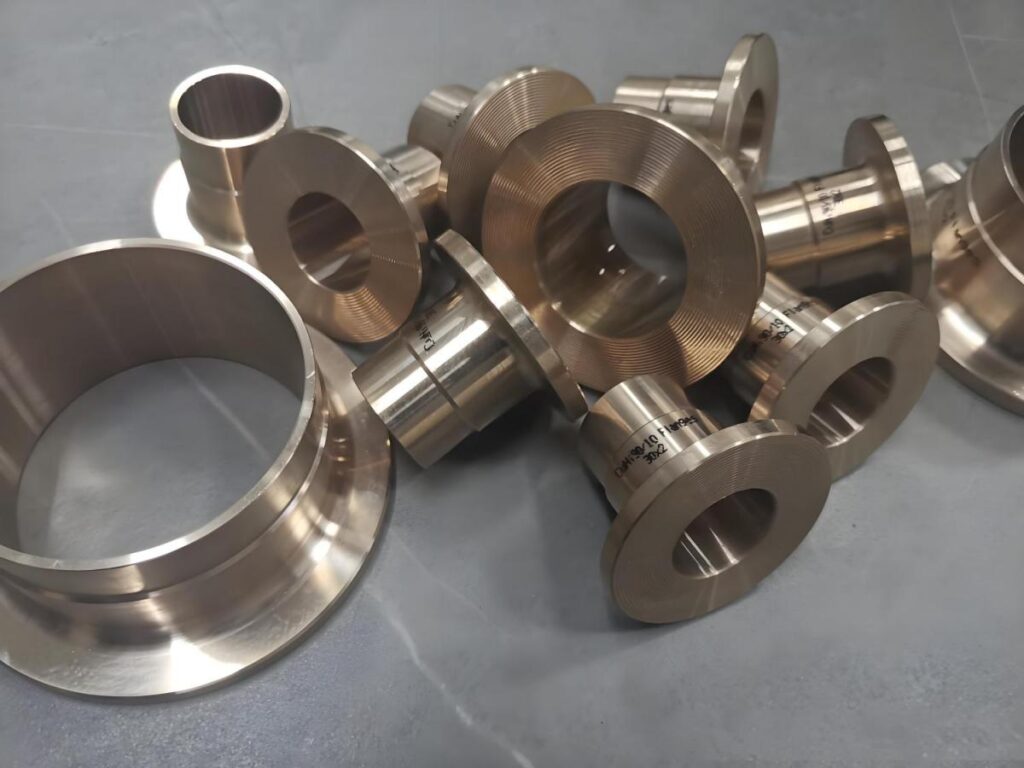
Cupronickel has been widely adopted across several industries due to its unique combination of physical, chemical, and mechanical properties. Here are some of the most prominent applications:
Marine Applications
Cupronickel’s resistance to seawater makes it a popular material for shipbuilding, desalination plants, and offshore oil platforms. It’s used in components like:
- Seawater pipes
- Condensers
- Heat exchangers
- Ship hulls
- Propellers
Electrical and Instrumentation
Due to its excellent electrical conductivity and corrosion resistance, cupronickel is used in:
- Thermocouples
- Electrical resistors
- Instrumentation tubing
Coinage
Many coins globally are made of cupronickel, as the alloy is durable and visually appealing. For example, U.S. Nickels and the outer layer of quarters and dimes are made of this alloy.
Automotive and Aerospace
Cupronickel is used in the manufacturing of brake lines, hydraulic suspension systems, and various aerospace components.
Medical Applications
Its biocompatibility makes cupronickel suitable for medical tools and implants, although it’s less common in this field compared to titanium and stainless steel.
Advantages and Disadvantages of Copper Nickel Alloy
Like any material, cupronickel has its strengths and limitations. Understanding these helps manufacturers and engineers make informed decisions about its use.
Advantages
- Corrosion Resistance: Cupronickel’s ability to resist rust and corrosion, especially in seawater, is unmatched, making it ideal for marine and industrial applications.
- Durability: The alloy’s strength and resistance to wear ensure long-lasting performance, reducing maintenance costs.
- Thermal Conductivity: Its ability to transfer heat efficiently suits it for heat exchangers and similar systems.
- Aesthetic Appeal: Cupronickel’s silvery sheen makes it suitable for decorative applications and coinage.
- Workability: The alloy is relatively easy to machine, forge, and form, allowing for complex designs.
Disadvantages
- Cost: Higher nickel content, as in 70/30 grades, can make cupronickel more expensive than other alloys like brass or stainless steel.
- Work-Hardening: During machining, the alloy can harden, requiring careful tool management to avoid defects.
- Limited Strength: While durable, cupronickel is not as strong as some high-performance alloys, limiting its use in applications requiring extreme mechanical strength.
By weighing these factors, industries can determine whether cupronickel is the right material for their needs, balancing performance with cost and application requirements.
Why Choose Precionn for Your Cupronickel Needs
When precision matters, and material performance is non-negotiable, Precionn stands as a reliable partner in the machining industry. Specializing in high-quality custom components, Precionn utilizes top-grade materials—including cupronickel—to meet the rigorous demands of international clients across marine, industrial, and engineering sectors. With a commitment to precision, innovation, and customer satisfaction, Precionn ensures that every machined part delivers outstanding durability and performance.
For more information on how Precionn can support your next project with expert machining solutions, visit our website or contact our team today.
FAQ: Common Questions About Cupronickel
Cupronickel does not rust in the traditional sense. Unlike iron-based alloys, it resists oxidation and corrosion, particularly in seawater. This property stems from the formation of a protective oxide layer that shields the material from environmental damage. For marine applications, this makes cupronickel a standout choice, as it maintains integrity even in harsh, salty conditions.
Most cupronickel alloys are non-magnetic or only slightly magnetic, depending on their composition. The 90/10 and 70/30 grades, commonly used in industry, exhibit negligible magnetic properties due to their high copper content. However, trace amounts of iron in some grades can introduce weak magnetism. For applications requiring non-magnetic materials, such as in electronics or sensitive instrumentation, cupronickel is often a safe choice.
Cupronickel is generally considered safe for most applications. It is non-toxic and widely used in environments where human contact is common, such as in coinage or food-processing equipment. However, as with any metal, prolonged exposure to fine particles or fumes during machining or welding requires proper safety measures, such as ventilation and protective equipment. For medical or food-related applications, ensure the alloy meets relevant regulatory standards.